UK
UK  EN
EN 


Choosing a platform for a company’s website is a strategic decision that determines the flexibility and stability of the business in the digital space for years to come. When faced with the task of creating a reliable website, people most often compare the two leading open-source, all-purpose CMS platforms on the market WordPress and Joomla.
Joomla and WordPress for small businesses operate on two different approaches to website development: one focuses more on structure and control, while the other emphasizes speed of launch and an ecosystem of ready-made solutions. In practice, the choice between them almost always comes down not to whether one is “easier or more difficult,” but to how the website is planned to grow and who will manage it after launch. Both systems are actively evolving, offer high performance, and are capable of handling tasks of any complexity. However, they have completely different architectures, content management logics, and approaches to data structuring.
WordPress: The King of Simplicity and Quick Start
WordPress firmly holds its position as the world’s most popular CMS. It has conquered the market thanks to its ease of use. Originally created as a blogging platform, it has now evolved into a versatile tool for developing all kinds of websites—from landing pages to large online stores.
Business Benefits:
-
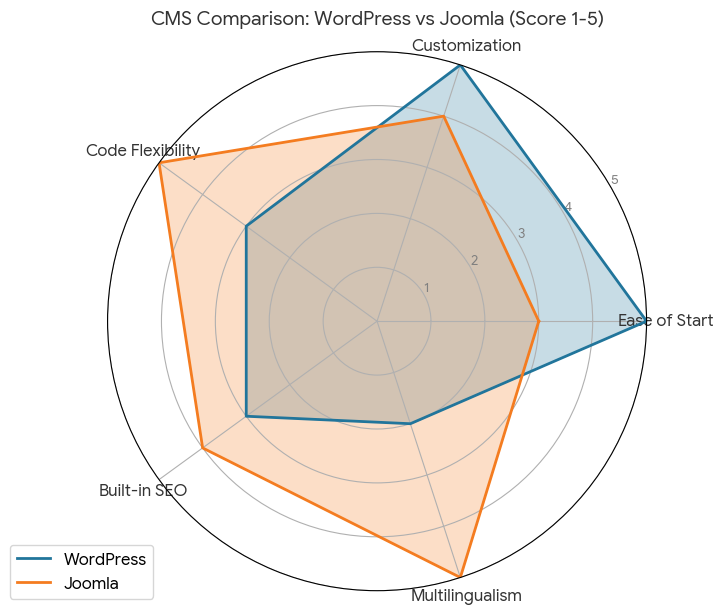
Low barrier to entry. In WordPress, the content model is simple: pages, posts, and post categories. This makes it ideal for service websites, blogs, and small directories. The admin panel interface is intuitive. You can manage content, publish news, or edit text without needing technical experts.
-
A vast ecosystem. There are tens of thousands of ready-made themes and plugins available for popular services. Therefore, integration with WordPress usually comes down to installing and configuring a plugin.
-
Cost-effectiveness from the start. You can build a basic website using a free theme and add the features you need through plugins. While some high-quality solutions are paid, competition is fierce, and there are always alternatives. Thanks to the platform’s popularity, website development and ongoing maintenance are usually more affordable due to the high level of competition among developers.
-
Performance and Load. WordPress can run very quickly, but this depends heavily on the number of plugins installed and the quality of the theme. In practice, most slow WordPress sites aren’t due to a system issue, but rather a result of being overloaded with plugins.
Disadvantages:
-
Dependence on plugins. Virtually any business feature—whether it’s a contact form, service booking, online store, or multilingual support—is implemented using pre-built modules. While this saves time, it creates a dependency on the quality of third-party solutions. A large number of plugins can significantly slow down page loading times and cause conflicts in the code.
-
Security issues. Due to its widespread popularity, WordPress is a prime target for hacker attacks and automated spam bots. The platform requires regular updates and high-quality security plugins.
Joomla: Power, Flexibility, and Structure
Joomla is considered a middle ground between the simplicity of WordPress and the complexity of professional frameworks. It offers much more powerful core functionality right out of the box. Joomla is often chosen when a more rigid data structure, a more complex content hierarchy, or multiple content types with different access permissions are required.
Business Benefits:
-
Flexible user management (ACL). If a team (managers, authors, editors, accountants) is working on the site, Joomla allows you to finely tune access rights for each user group without the need for third-party extensions.
-
Built-in multilingual support. The creation of multilingual website versions is implemented at the system core level. This is critically important for Ukrainian businesses that operate in both the domestic market and the export market.
-
Working with complex structures. Customizing content types, managing large multi-level product or service catalogs, and organizing nested categories in Joomla are implemented in a more architecturally sound and reliable manner. In Joomla, content is more flexible: you can build complex structures of materials and categories and create different content types with specific parameters. This is useful when a website goes beyond the standard “service + description + contact information” framework.
Disadvantages:
-
A more complex interface. The system requires an understanding of its structure. For someone accustomed to a chaotic layout, the logic behind the modules and menus may take some getting used to at first, but it pays off in the long run with full control over the site.
-
Fewer ready-made solutions. The Joomla community is smaller, so finding a specific plugin or a high-quality, modern template may take longer. However, while Joomla has fewer extensions, they are often more “engineered”—with an emphasis on control and structure. There are fewer integrations, but they tend to be more stable in complex configurations.
What Ranks Better on Google (From an SEO Perspective)
From an SEO perspective, Google does not automatically favor any particular CMS. The search bot evaluates the end result: page load speed (Core Web Vitals), mobile responsiveness, proper semantic markup, and content uniqueness.
-
WordPress offers popular tools like Yoast SEO or Rank Math, which automate technical SEO even for beginners.
-
Joomla features powerful built-in optimization tools: you can manage meta tags, redirects, and micro-markup without installing any additional components. In addition, the latest versions of the system demonstrate excellent code cleanliness and speed.
The success of the promotion depends entirely on the professionalism of the webmaster who configures the site's technical settings.
The Final Verdict: What Should a Company Choose?
The choice of website architecture should depend on the specifics of business processes and plans for scaling.
WordPress — this is an option for quick, standard solutions. If a business simply plans to “grow in terms of page count and traffic,” WordPress is generally sufficient. It’s a good fit if you need to launch a simple business card website or a one-page landing page quickly using pre-made templates, and you’re willing to accept some compromises in architecture in order to get started quickly.
Joomla — this is the right choice for those looking to build a professional, well-structured business website. It is ideal for corporate portals, service websites with complex hierarchies, and projects that require rock-solid stability, multilingual support, and precise control over every module from the very start.
 DOWNLOAD BRIEFS