UK
UK  EN
EN 


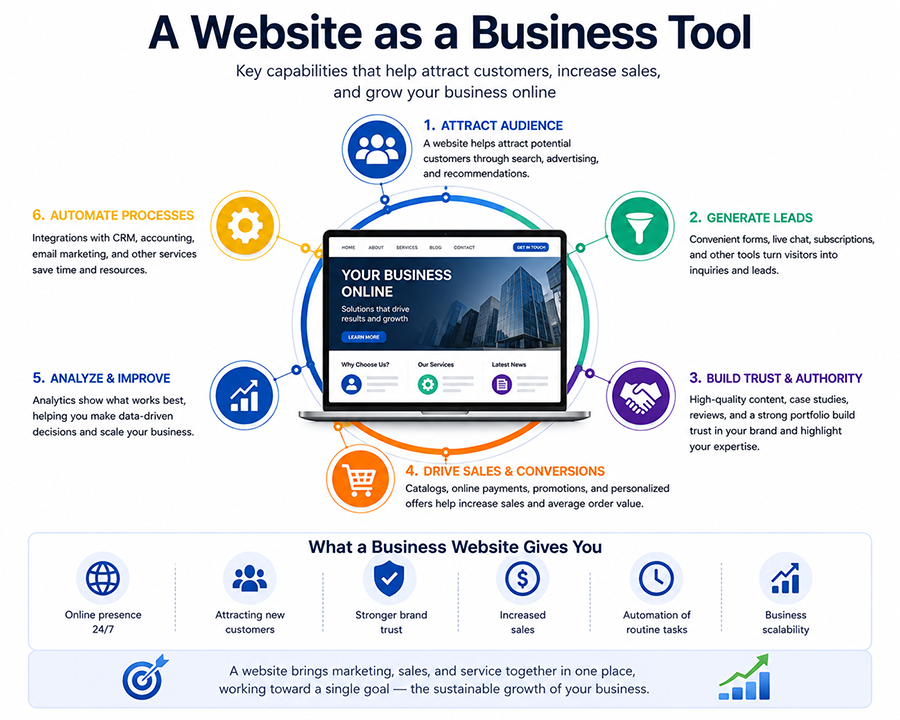
A modern independent website is far more than a mere digital business card; it is a robust tool for sales, communication, and business growth. Unlike social media and SaaS platforms, it belongs entirely to the company and remains unaffected by third-party algorithms or the limitations of outside services. Operating around the clock, it ensures continuous access to information, attracts new customers, automates workflows, and builds long-term brand trust.
This digital platform is essential across all sectors:
- B2B & Corporate: Manufacturing enterprises, medical centers, and legal firms.
- Services & Education: Service providers, online schools, and niche specialists.
- Creative Industries: Artists, designers, photographers, and portfolio-driven projects.
Depending on business goals, the solution can range from a concise website for a quick presentation to a hybrid web system designed to automate business processes, streamline team collaboration, and manage company assets. Comprehensive solutions seamlessly combine informative content, such as a corporate blog, with the core features of an e-commerce store or a product catalog.
Core Functionality and Content Management
A Content Management System (CMS) serves as the essential foundation for any high-performing website. Its main advantages are flexibility and ease of use, allowing a manager to update information quickly without hiring developers or knowing how to code. Thanks to modern CMS architecture, a custom solution can be scaled to any size. You can easily add new sections, integrate third-party services, and modify functionality as your business grows. This allows you to expand your operations without the need to rebuild the project from scratch, making this digital presence a foundation for long-term online growth.
The Essential Technical and Content Checklist Includes:
- Template Customization: The pre-built solution is fully tailored to the client's corporate identity, including custom color palettes, typography, and logo integration.
- Intuitive Navigation: A multi-level main menu and additional sidebars.
- Internal Search: A dedicated search bar designed for fast and convenient retrieval of information across all pages.
- Multimedia Integration: Interactive photo and video galleries, along with dynamic sliders.
- Trust & Credibility: Custom-built sections for "Clients" and "Partners," alongside an "About Us" page showcasing licenses, certificates, and awards.
- Audience Engagement: Live chat assistance, order forms, newsletter subscription, interactive maps, and diverse communication channels within the contact section.
- Content Management: Structured product catalogs, information pages, and up-to-date price lists. Initial content population enables a rapid project launch, while new materials can be effortlessly added while the platform is live.
Business Website vs. Corporate Website: What's the Difference?
These formats have much in common, yet they fundamentally differ in scale, structure, target audience, and objectives. By its very nature, any corporate web asset is a digital tool for busines, but far from every company requires such large-scale development—for many niches, a landing page or a high-quality brochure website is sufficient.
Business Website (Broad Definition)
An overarching term for any online platform engineered to drive sales, generate leads, and establish a digital brand presence. It encompasses several distinct solutions:
- Brochure Website: A concise 5–7 page project designed to present the services of an independent specialist (such as a lawyer, consultant, or accountant) or outline the operations of small local businesses and studios.
- Landing Page: A focused, high-conversion single-page setup created to promote a specific product, service, or targeted offer.
- Multi-Page Service System: A full-featured commercial platform tailored for service providers, featuring detailed service catalogs, transparent pricing structures, and integrated booking tools.
- E-commerce Store: A full-featured online solution with an integrated product catalog, shopping cart, and secure payment gateways.
The primary goal: rapid acquisition of targeted traffic, lead generation, and immediate conversions.
Corporate Website (Specific Definition)
A scalable, multi-functional web platform that represents an enterprise, holding company, or global brand. Beyond consumer engagement, it serves as a central hub for interacting with partners, investors, media, and internal stakeholders.
Its Key Features:
- Complex Structure & Architecture: Dozens or hundreds of pages housing corporate history, mission statement, leadership details, press releases, tender documentation, and shareholder financial reports.
- Image & Reputation Focus: A strategic priority on market positioning, showcasing industry expertise, operational scale, and corporate credibility.
- Deep Technical Integrations: Dedicated partner and dealer sections, along with direct synchronization with internal automation systems (CRM, ERP, inventory management, and databases).
The primary goal: brand capitalization, long-term trust building, operational process automation, and full digital representation of corporate interests.
Which Option to Choose for Your Project?
For the majority of companies, a business website is the optimal choice. It balances high-performance marketing capabilities, flexibility, reasonable development costs, and strong potential for organic SEO. This format satisfies all the requirements of small and medium-sized enterprises without overloading the project with unnecessary features.
A comprehensive corporate platform becomes essential only when an organization scales into a large enterprise and standard marketing tools are no longer enough. If your primary goals are to attract customers, establish trust, and expand your digital footprint, a high-quality business website will completely meet these needs.
 DOWNLOAD BRIEFS